
Service
Rodent Proofing
Closing the entry points rodents use, so the attic and crawl space stay sealed after the work is done.
Overview
What this service covers
Rodent proofing closes the openings animals use to get into an attic or crawl space. It matters to insulation work for a practical reason: rodents tunnel through and compress material, leave droppings and nesting behind, and tend to reuse the same entry points. Replacing insulation without closing those openings puts new material in front of the same problem.
When it may be recommended
Rodent proofing may be recommended where there is evidence of activity in the attic or crawl space, and it is normally carried out before or with insulation work rather than after it. What can be closed depends on the construction and on what is reachable — an on-site assessment confirms the appropriate scope.
What it addresses
Conditions this work is meant for
They are not a diagnosis of your home.
Droppings or nesting found in the insulation
Contaminated material does not perform the way it was rated to, and it is one of the more common conditions found on an attic floor.
Tunnels and flattened runs through the material
Compressed paths through insulation are both a sign of activity and a direct loss of performance along every run.
Open or damaged foundation vents
Vents with missing, rusted or torn screening are a standing entry point into the crawl space.
Gaps at the roof line, eaves and utility penetrations
Openings where the roof meets the wall, and where pipes or wiring enter the structure, are common access points.
The Process
How the work is carried out
The order matters more than the brand on the bag. Steps can change once we see the space.
Identify the entry points
We look at the foundation vents, the roof line and eaves, utility penetrations, and anywhere the structure has an opening large enough to be used.
Assess the contamination
The condition of the existing insulation is recorded, since contaminated material generally needs to come out rather than be worked around.
Close the openings
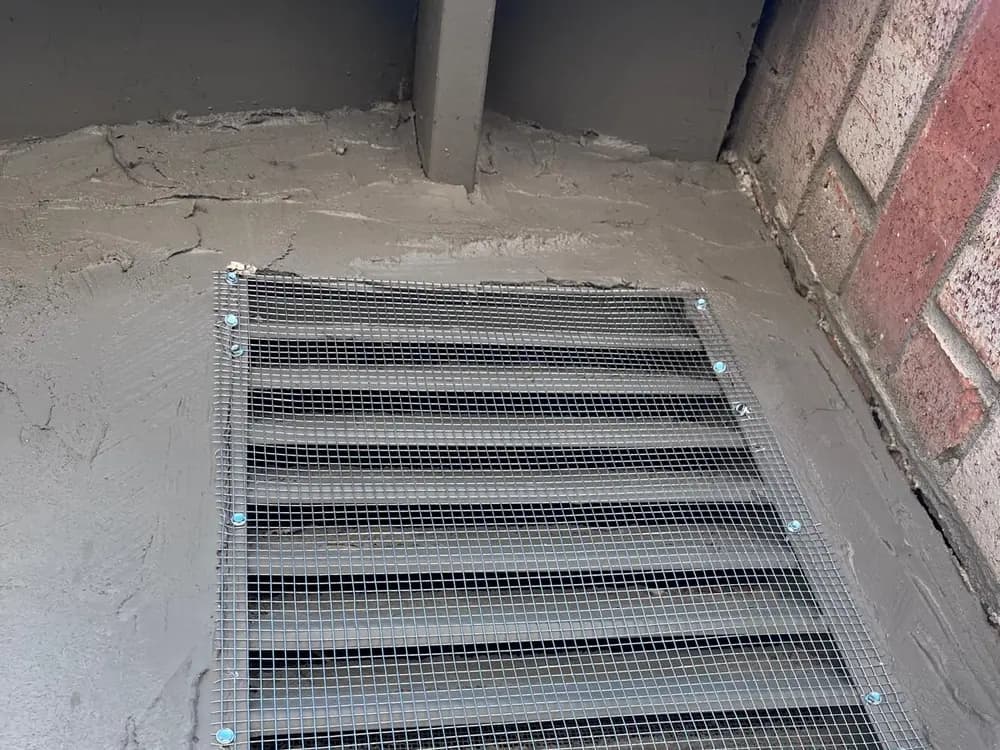
Foundation vents are covered with galvanized mesh, fastened at the edges and mortared into the surrounding wall where that is what the opening calls for. Other penetrations are closed with material suited to their location.
Seal the perimeter of each closure
A screen that is fixed at four points but open along its edge is not closed. Each covering is sealed along its full perimeter.
Coordinate with the insulation work
Where contaminated material is being replaced, the openings are closed first, so the new insulation goes into a sealed space.
Details
What gets closed
- Foundation vents
- Galvanized mesh, fastened at the edges and mortared in where appropriate.
- Roof line and eaves
- Openings where the roof meets the wall, closed with material suited to the gap.
- Utility penetrations
- Points where pipes, wiring or ducts pass through the structure.
- Sealing
- Each closure is sealed along its full perimeter, not only fixed at its corners.
- Scope note
- This is exclusion work on the building. It is not pest extermination, and it does not include trapping or chemical treatment.
Our Work
Rodent Proofing jobs we have photographed
Photographs from EB Insulation jobs filed under this service, including the conditions found before the work started.
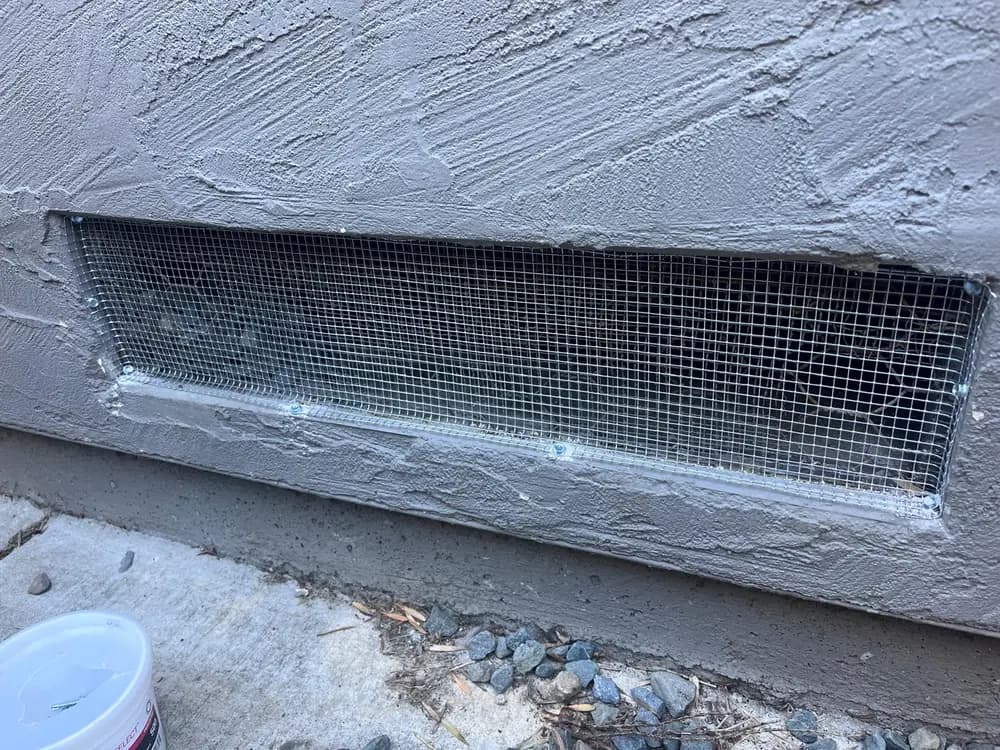
Perimeter vent sealed against entry
Related
Services that often go with this one
Questions
About rodent proofing
General guidance. It does not replace an assessment of the actual space.
How does rodent activity affect existing insulation?
Rodents tunnel through and compress insulation, which reduces how well it performs, and they leave droppings and nesting material behind. They also tend to reuse the same entry points, so closing those openings is what keeps the problem from returning after the material is replaced.
Is this pest control?
No. This is exclusion work on the building itself: finding the openings and closing them. It does not include trapping, baiting or chemical treatment, and it is not offered as a substitute for a licensed pest control service where one is needed.
Should this happen before new insulation?
Generally yes. Installing new material while the entry points are still open puts it in front of the same conditions that ruined the last layer. Where both are in scope, the openings are closed first.
Request an estimate for rodent proofing
We look at the space before recommending a scope, because what is actually there decides what is worth doing.