
Service
Air Sealing
Sealing the gaps, joints and penetrations that let conditioned air escape into the attic before new insulation goes in.
Overview
What this service covers
Air sealing closes the gaps, joints and penetrations in the ceiling plane that let conditioned air move between your rooms and the attic. It is the step that comes before insulation, because insulation slows heat but does not stop air from travelling through an opening. Once new material is laid across the attic floor, those openings become difficult to reach again.
When it may be recommended
Air sealing may be recommended whenever work is planned on the attic floor, and particularly where insulation is about to be added or replaced. What is actually open, and how much of it can be reached, depends on the condition of the attic — an on-site assessment confirms the appropriate scope.
What it addresses
Conditions this work is meant for
They are not a diagnosis of your home.
Drafts you cannot trace to a window or door
Air moving through recessed lights, plumbing chases or the gaps around ductwork often reads as a draft in the room below, with no obvious source at eye level.
Insulation that was added without sealing first
A common finding is new material laid straight over unsealed penetrations. The attic looks finished, and air keeps moving through it exactly as before.
Dust or attic smell entering the living space
Where air travels from the attic into the house, it carries whatever is in the attic with it. That path is usually the same one losing conditioned air in the other direction.
Uneven temperatures between rooms
Leakage is rarely spread evenly across a ceiling. Rooms sitting under the leakiest section tend to be the ones that never settle.
The Process
How the work is carried out
The order matters more than the brand on the bag. Steps can change once we see the space.
Inspect the ceiling plane
We go into the attic and look at the surface between the attic and the rooms below: junction boxes, can lights, pipe and wire penetrations, duct boots, bath fan housings, and the joints where framing meets the ceiling material.
Clear what is covering it
Existing insulation is pulled back or removed from the areas that need sealing. Nothing can be sealed through a layer of loose-fill, so this step decides how complete the work can be.
Seal the penetrations
Each opening is closed with a material suited to it: sealant at small gaps and seams, and rigid or fire-rated treatment where the penetration is larger or sits near a heat source such as a flue.
Seal the framing joints
The seams where the ceiling material meets the joists are run as well, since a long thin gap can move as much air as one obvious hole.
Re-cover and clean up
Insulation goes back over the sealed plane, or new material is installed if that is part of the job, and the work area is cleaned before we leave.
Details
Where the work happens
- Work area
- The attic side of the ceiling plane, reached through the existing attic access.
- Typical targets
- Electrical junction boxes, recessed light housings, plumbing and wiring penetrations, duct boots, exhaust fan housings, and top plates where framing meets the ceiling.
- Materials
- Sealant and, where the opening requires it, rigid backing or fire-rated material. The specific product depends on the location and clearance requirements.
- Sequence
- Sealing precedes insulation. Where both are in scope, they are carried out as one visit.
Our Work
Air Sealing jobs we have photographed
Photographs from EB Insulation jobs filed under this service, including the conditions found before the work started.
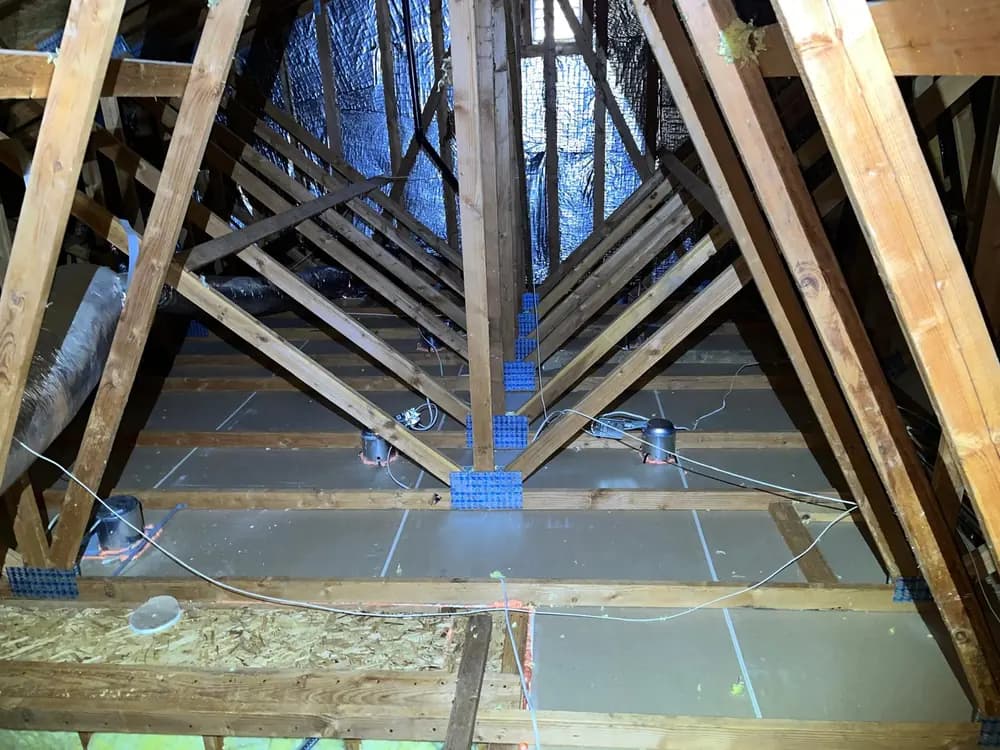
Attic cleared down to the ceiling plane, ready for sealing
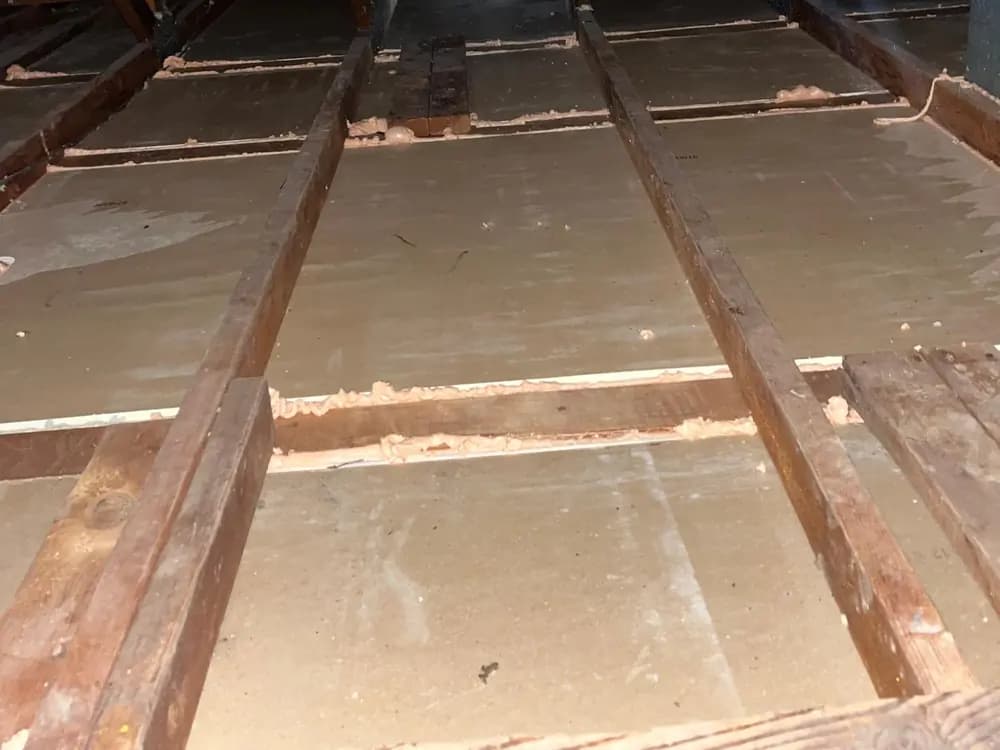
Sealant applied along the joints between framing members
Related
Services that often go with this one
- Attic InsulationInsulation installed across the attic floor so the ceiling plane between the attic and the living space performs as it should.
- Radiant BarrierReflective material installed at the roof deck to reduce radiant heat transfer from a sun-heated roof into the attic.
- Attic FanPowered ventilation that moves hot air out of the attic, specified for attics where it suits the roof and ventilation design.
Questions
About air sealing
General guidance. It does not replace an assessment of the actual space.
Why does air sealing have to happen before insulation?
Insulation resists heat moving through a surface; it does not block air moving through a hole. If the penetrations are still open, air keeps travelling between the attic and the house, and adding material on top covers the openings without closing them. It also makes them much harder to reach afterwards, since the sealing points are now under a layer of insulation.
Can it be done without removing the existing insulation?
Partly. Insulation can be pulled back from the areas that need sealing and put back afterwards, which works when the material is in reasonable condition. Where it is compressed, damp or contaminated, removal is usually the more sensible route, and that is a decision made after looking at the attic.
Is this the same as caulking around windows and doors?
No. Window and door sealing addresses the walls. This work addresses the ceiling plane between the living space and the attic, which is where warm air tends to collect and where the largest unsealed openings in a house are usually found.
Request an estimate for air sealing
We look at the space before recommending a scope, because what is actually there decides what is worth doing.