
Service
Attic Fan
Powered ventilation that moves hot air out of the attic, specified for attics where it suits the roof and ventilation design.
Overview
What this service covers
An attic fan is powered ventilation that moves hot air out of the attic. It is one option among several, and it is specified rather than assumed: on an attic with significant air leakage at the ceiling plane, a powered fan can pull conditioned air out of the living space along with the attic air. That is why sealing comes first.
When it may be recommended
An attic fan may be recommended where the roof and ventilation design suit it and the ceiling plane below has already been sealed. It is not appropriate for every attic, and installing one over significant air leakage can make the situation worse rather than better — an on-site assessment confirms whether it is the right call.
What it addresses
Conditions this work is meant for
They are not a diagnosis of your home.
An attic that holds heat late into the day
Where existing passive ventilation is limited by the roof design, warm air can sit in the attic long after the outside temperature has dropped.
Limited or poorly balanced existing ventilation
Intake and exhaust need to work as a pair. An attic with exhaust but little intake, or the reverse, does not move air the way its design intended.
Moisture accumulating in the attic
Air movement is one part of managing attic moisture, though the source of the moisture matters more than the ventilation does.
The Process
How the work is carried out
The order matters more than the brand on the bag. Steps can change once we see the space.
Assess the existing ventilation
We look at what intake and exhaust the roof already has, how they are balanced, and whether the attic's problem is actually a ventilation problem.
Check the ceiling plane first
If the ceiling plane is leaking air, that gets addressed before a fan is considered, because a powered fan on a leaky ceiling draws conditioned air up out of the rooms below.
Position the unit
The fan is located for the roof structure and the airflow path, so it exhausts attic air rather than short-circuiting against a nearby intake.
Mount and duct
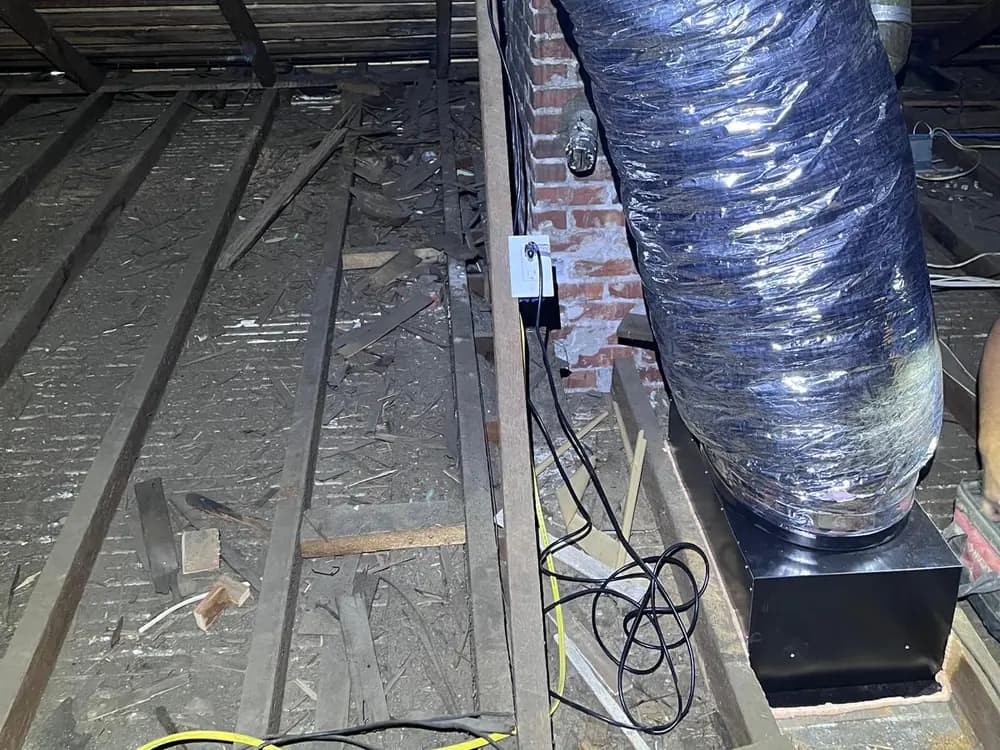
The housing is fastened to the framing and connected to insulated ducting where the run requires it, routed to the roof or gable vent.
Connect and test
Electrical connection is made and the unit is run to confirm it moves air in the intended direction.
Details
What the installation involves
- Location
- Mounted to the attic framing, exhausting through a roof or gable vent.
- Ducting
- Insulated flexible duct where the run between the unit and the vent requires it.
- Prerequisite
- A sealed ceiling plane below. Sealing is carried out before a fan is installed.
- Depends on
- Roof design, existing intake and exhaust ventilation, attic access, and available electrical supply.
- Not universal
- Some attics are better served by improving passive ventilation or by work at the ceiling plane instead.
Our Work
Attic Fan jobs we have photographed
Photographs from EB Insulation jobs filed under this service, including the conditions found before the work started.
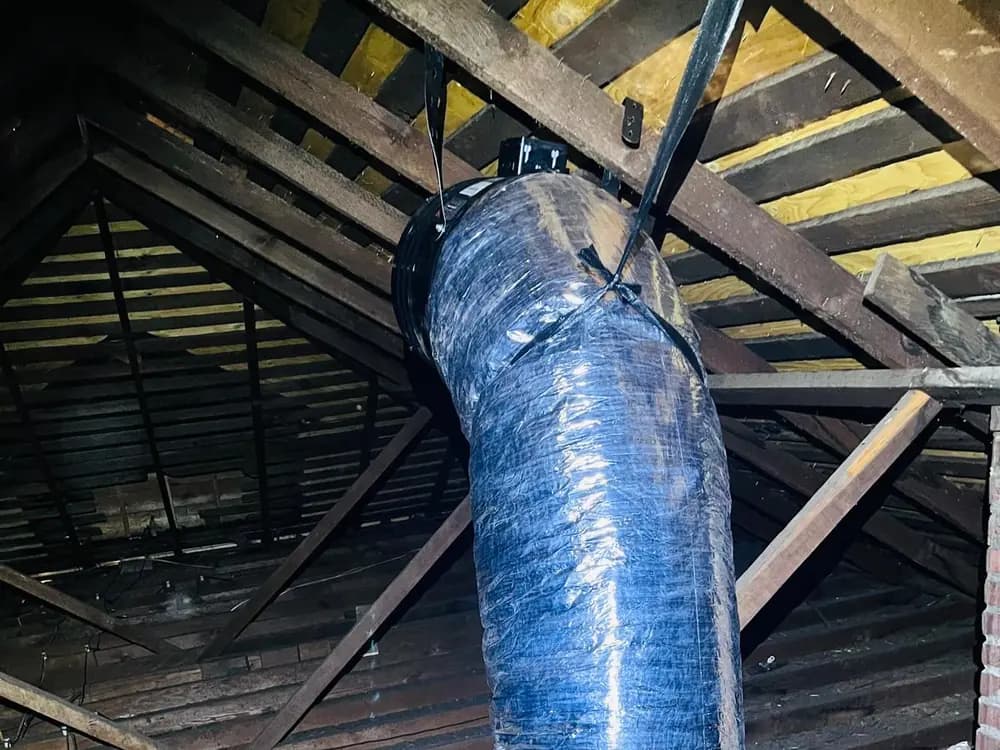
Ducting routed to the roof vent
Related
Services that often go with this one
- Air SealingSealing the gaps, joints and penetrations that let conditioned air escape into the attic before new insulation goes in.
- Attic InsulationInsulation installed across the attic floor so the ceiling plane between the attic and the living space performs as it should.
- Radiant BarrierReflective material installed at the roof deck to reduce radiant heat transfer from a sun-heated roof into the attic.
Questions
About attic fan
General guidance. It does not replace an assessment of the actual space.
Does every home need an attic fan?
No. Whether one makes sense depends on the existing ventilation, the roof design and how well the ceiling plane below is sealed. Installed on an attic with significant air leakage, a powered fan can pull conditioned air out of the living space, which is the opposite of the intended result.
Is this the same as a whole-house fan?
No. An attic fan ventilates the attic. A whole-house fan pulls air from the living space and exhausts it through the attic, which is a different system with different requirements. This service covers attic ventilation.
Why does air sealing have to come first?
A fan lowers the pressure in the attic so air leaves through the vent. If the ceiling plane has unsealed openings, some of the air it pulls comes from the rooms below rather than from outside. Sealing the ceiling plane is what keeps the fan working on attic air.
Request an estimate for attic fan
We look at the space before recommending a scope, because what is actually there decides what is worth doing.